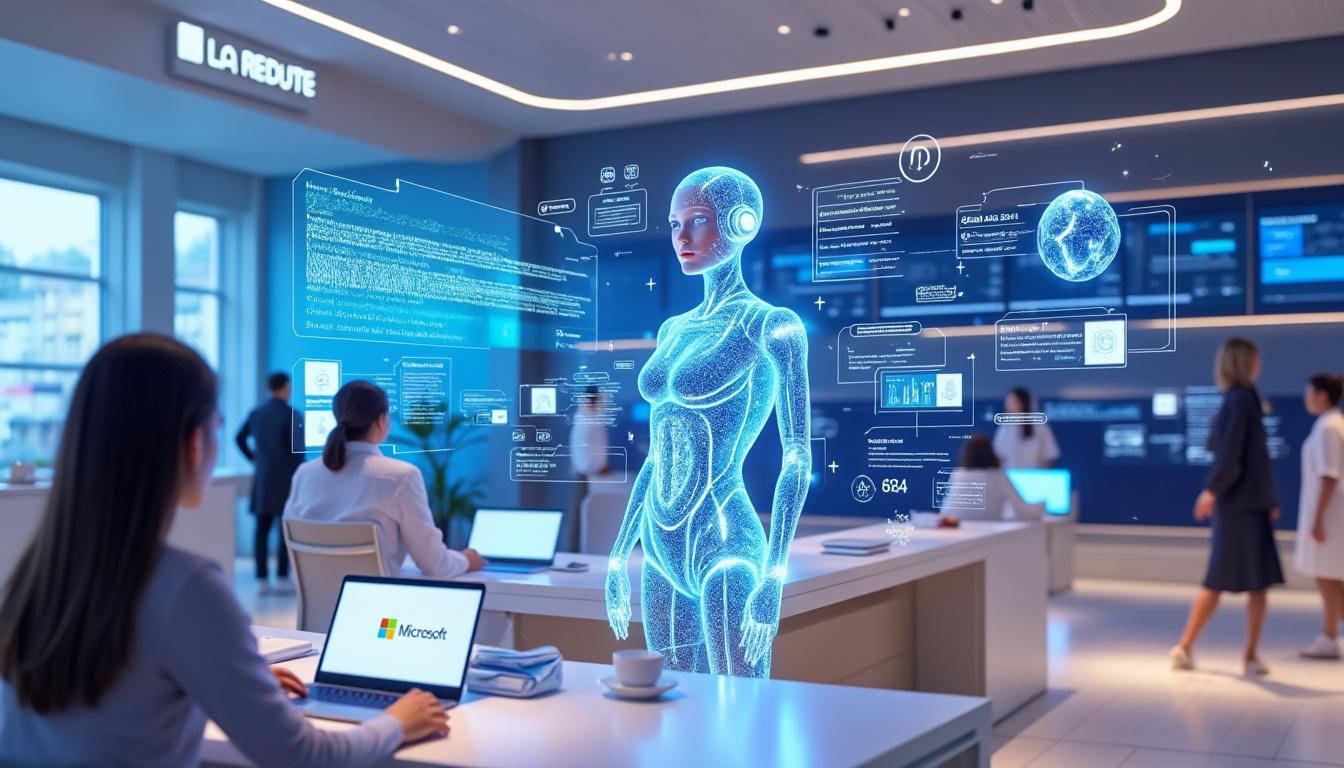
La Redoute and Microsoft: the artificial intelligence agent as an essential partner in customer relations
In a world where customer experience has become paramount, companies are turning to innovative solutions to improve their customer relationships. La Redoute, a major player in distance selling, recently integrated an artificial intelligence agent through its strategic partnership with Microsoft. This development aims not only to optimize customer service automation, but also to completely transform the user experience. Let’s discover how this initiative was implemented and the benefits it brings.
The Foundations of an Innovative Project: La Redoute and Microsoft
La Redoute’s artificial intelligence agent development project was no accident. After three months of intense reflection, the company decided to lay the foundations for a collaboration with Microsoft, a key partner in the technology field. This alliance aims to provide a solution to the growing challenges of customer relations. During this process, one element particularly stood out: caution. As project manager Sophie Brief explains, “We started cautiously, taking care not to degrade the customer experience while maintaining human control over the technology.” This is essential to ensure that automation complements, not replace, the human touch. This project began in France, a strategic choice since the country accounts for 60% of the company’s revenue. Jean-Cédric Costa of the La Redoute group explains: “France remains the most advanced in terms of customer relations.” This choice allowed the company to test the AI agent by initially focusing on the most frequently asked questions in their FAQs, which are already well-established on their website and mobile app.The conversational agent and generative AI
To address customer service challenges, La Redoute opted for the use of generative AI, leveraging Azure OpenAI Service. According to Jean-Cédric Costa, “The availability of Azure OpenAI Service’s Large Language Models and their ease of access bring real added value.” This demonstrates the growing importance of qualified, secure, and accessible data in implementing an effective AI solution. This innovative approach is based on clear and precise principles:Pragmatism:
Each step is carefully considered to ensure that the tool improves the customer experience without obstacles. Team Education:Employees are trained to understand this technology and its impact on their workplace.
Iteration:
Continuous adjustments are made based on feedback obtained during testing.A well-designed AI agent doesn’t just respond; it learns and improves based on interactions. La Redoute is thus at the forefront of developing an optimized relationship with its customers.Acculturating Teams: A Major Challenge
To ensure the success of this project, La Redoute has understood that it is essential to acculturate its teams to the use of this new technology. To this end, workshops are being organized with Microsoft to help staff master the technological building blocks implemented. This educational process includes:
- Training sessions on AI concepts and their application in customer service. Feedback on best practices for using the AI agent.
- The creation of a dedicated team to support the cultural change within the company. Jean-Cédric Costa affirms that these initiatives allow the relevance of customer information to be challenged. “From its creation to its launch, the chatbot has been a powerful learning tool,” he emphasizes. Thanks to this approach, La Redoute is not only adapting, it’s innovating, while ensuring personalized responses to customer requests.
- Tangible gains after deployment It’s still early to draw a definitive conclusion, but the initial feedback is impressive. Deployed only a few months ago, the artificial intelligence solution has already exceeded the company’s initial expectations. Of the 150,000 conversations recorded between customers and the intelligent assistant, 40% of responses were efficiently handled without human intervention. This statistic is all the more significant in a sector where 50% of consumers prefer telephone contact.
La Redoute advisors have noticed an improvement in their daily work:
Requests are better qualified and require fewer interventions. Contact reasons are focused on more complex issues, making it easier to serve each customer.
Flows directed toward human agents are reduced, thus improving their productivity.
- Jean-Cédric Costa is enthusiastic: “For every euro spent, we save an average of 60 to 70 euros.” These impressive results illustrate the financial benefits of such an initiative, while highlighting the importance of a well-orchestrated digital transformation.
- Toward a promising future: increased personalization of the customer journey
- Encouraged by these successes, La Redoute’s teams are seeking further opportunities for improvement. One of their priorities is to integrate the artificial intelligence agent into messaging apps like WhatsApp. This development will enable the AI assistant to provide more precise and situation-specific responses.
Jean-Cédric Costa notes that “the interactions handled by the AI agent give us access to crucial information about customer journeys,” which will facilitate even greater personalization in the future. Project Objectives Results Achieved Future Steps
Optimize customer service automation
40% of conversations managed without human intervention
Integration with WhatsApp
- Improve team training
- Increase advisor productivity
- Ongoing training sessions
Personalize the user experience
Better qualification of customer requests
Customer data analysis for increased personalization La Redoute’s long-term vision is to move towards more sophisticated and autonomous AI agents. While this represents a challenge, we must not lose sight of the importance of trust and quality in the responses provided to customers. Sophie Brief concludes by emphasizing: “Whatever our approach, our priority remains to improve our proactivity towards our customers, without ever neglecting the quality of service.”
Catégories : Non classé
Tags : artificial intelligence, customer relationship, essential partner, microsoft, the redoubt