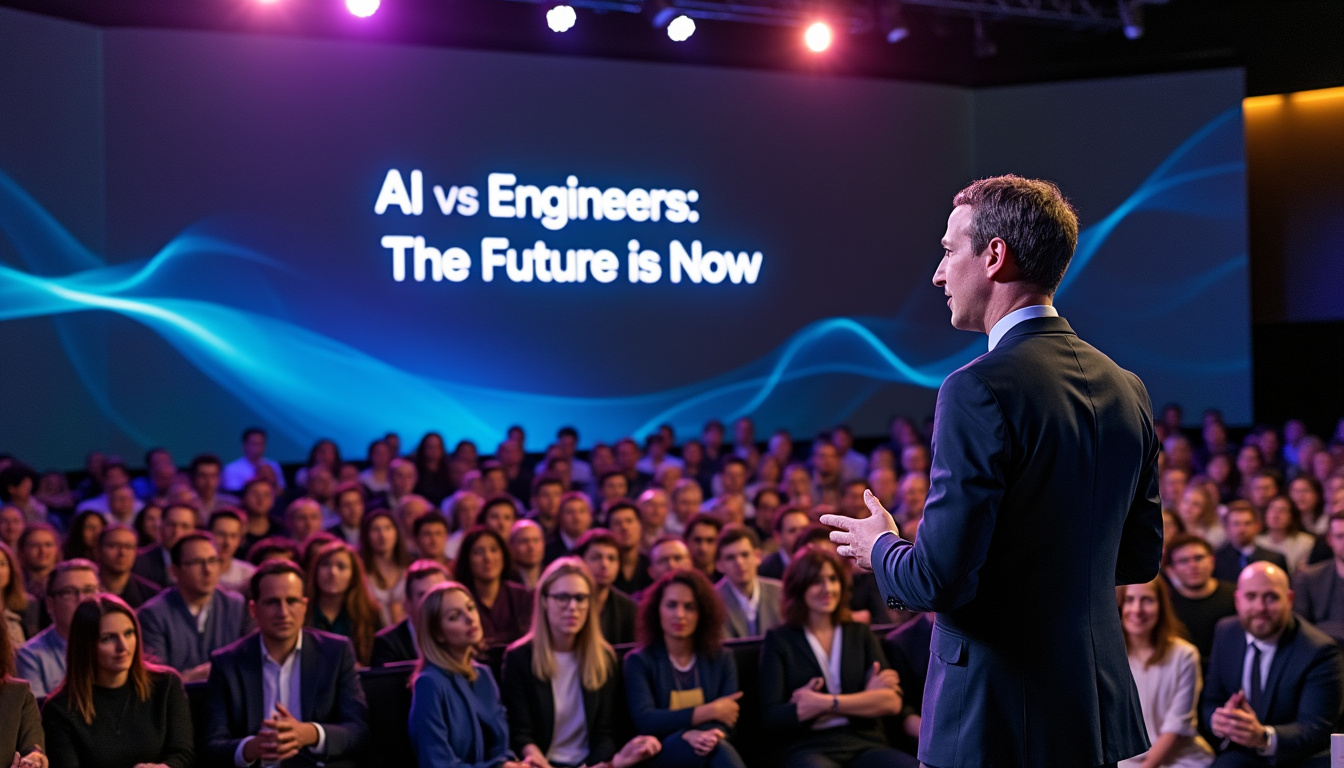
Mark Zuckerberg predicts that AI will be able to compete with engineers this year
Recently, Meta CEO Mark Zuckerberg made announcements that could transform the software development landscape. Its plan to develop artificial intelligence agents capable of handling complex programming tasks starting this year raises many questions and opportunities about the future of developers. The implications of these technological advances could redefine not only technology-related occupations, but also the entire job market.
Zuckerberg’s predictions, which highlight Meta’s Llama model, indicate that it is possible for an AI agent to reach a level of expertise comparable to that of a mid-level engineer by 2025. This represents a potential disruption with the past, where the role of human developers was indisputable. Thus, the industry is at the dawn of a revolution accompanied by new challenges but also promising innovations.
AI agents, a new horizon for software development
THE AI agents are seen as future collaborators of developers. The potential of these technologies lies in their ability to automate tasks that today require human intervention. Zuckerberg clarified that while some of the advanced capabilities of AI agents could be expected as early as 2025, full implementation may not be feasible until 2026.
Zuckerberg’s vision for the year 2025 includes AI agents that not only code, but also have skills analogous to those of a good mid-level engineer. This technological shift could mean that engineers will focus more on strategic and innovative tasks, unlocking their creative potential while handing over repetitive and technical tasks to AI.
What this means for developers
The rise of artificial intelligence agents in the development field could also pose significant professional challenges. While some tasks may be carried out by AI agents, it is also possible that many human positions will be put to the test. Developers will need to adapt by developing skills that complement those of AI, focusing on areas where human creativity and critical judgment remain essential.
Economic impact of AI on employment
The economic implications of the rise of AI agents are vast. As Zuckerberg points out, companies that are able to develop these technologies will have a significant strategic advantage. Not only could AI reduce costs related to hiring and employment, but it would also enable increased agility in software development, making the process more efficient.
This development could create pressure on developer salaries, especially those at mid-level. With a AI capable of replacing some of their functions, the added value of developers will have to be redefined to guarantee their place in the sector. The key will be to focus on improving technical skills and expertise in order to stay relevant in a rapidly changing market.
The importance of Llama and other open source initiatives
To achieve this objective, Meta is banking on its Llama model which, according to Zuckerberg, should become the benchmark in the sector. The strategy of making Llama open source aims to match the performance of closed models, but also to encourage innovation within the developer community. The version Llama 4.0, currently in development, is expected to incorporate agent capabilities, thereby increasing the capabilities of AIs and their real-world applications. With the help of a large developer community, Meta hopes that a robust ecosystem will be created around Llama, contributing to even more significant advancements.
Meta’s response to the competition
With the rise of AI, competition in the field is becoming increasingly fierce, particularly from the Chinese company DeepSeek. Zuckerberg recognized the advances made by DeepSeek and is aware of the challenges this competition represents. The innovations brought by DeepSeek encourage Meta to redouble its efforts to stay ahead in the AI race.
The ability to set a global standard for open source AI is essential. Zuckerberg defended a vision where this standard would be American, an approach which aims to promote ethical and technical standards to be adopted by the entire sector. Meta’s ability to continue to innovate while ensuring the security and reliability of its AI will be critical to its future success.
Collaboration and integration of innovations
Collaboration is a fundamental aspect for moving forward in the development of artificial intelligence. Integrating innovations presented by other market players, such as DeepSeek, could allow Meta to accelerate its own development process. By ensuring its AI remains relevant and current, Meta will seek to build a future where artificial and human intelligence work hand in hand to drive technological progress.
The transformation of the role of engineers
As AI agents begin to take on traditionally human responsibilities, the role of engineers is evolving. Developers must now consider their work in an environment coexisting with artificial intelligence. This could involve establishing a balance where human and AI skills complement each other.
Redefining the responsibilities of engineers
With the implementation of AI agents, engineers will no longer be solely responsible for programming. On the contrary, they will become facilitators, moderators of AI who will ensure that these tools work effectively. This will require a shift in mindset, where collaboration with AI is seen as an opportunity and not a threat. The technical challenges that these changes will pose will need to be approached with creativity and innovation, notably by reviewing existing development processes.
Support and continuing training
Companies will need to invest in ongoing training for their employees to ensure they have the skills needed to work alongside AI agents. Training programs could include modules on human-computer interaction, AI ethics and new technologies, allowing engineers to stay up to date on the latest trends. In addition, the implementation of internal training and experience sharing sessions could strengthen employee confidence in the use of AI technologies.
Sustainability of professions in the face of AI
Faced with the emergence of AI technologies, the question of the sustainability of professions naturally arises. Fears linked to the disappearance of certain positions confront the reality of a constantly evolving technological sector. The engineering professions, although under pressure, will have to adapt to survive and prosper.
A future shared between humans and artificial intelligence
Digital transformation driven by AI could also open the door to new professions. This development could lead to positions related to the management and supervision of artificial intelligence, as well as roles in the ethics and regulation of these emerging technologies.
Strategies for a Sustainable Career in an AI-Driven World
Engineers will be required to specialize in areas requiring strong human intervention, such as creativity, decision-making and complex project management. Furthermore, developing communication and leadership skills will be crucial to support professional transitions. Companies that invest in developing the skills of their employees will have an advantage in the market.
The future prospects of AI in industry
Looking to the future, it seems clear that artificial intelligence will continue to play a major role in the evolution of the technology industry. Zuckerberg’s predictions regarding the rise of autonomous AI agents raise the question of the next steps for the development of these technologies. Businesses will need to focus on the balance between innovation and integrating AI into their existing processes.
A constantly changing technological landscape
Market dynamics will change, requiring continued flexibility and adaptability. Companies that successfully integrate innovations while maintaining ethical standards will attract not only customers, but also talent. Organizations will have every interest in collaborating to progress together in this era of augmented intelligence.
Cultivating resilience in the face of technological change
To navigate a fast-paced technological environment, resilience will be essential. Professionals will need to be willing to learn and evolve, embracing change rather than resisting it. The ability to quickly adapt and take advantage of new technologies will be a critical success factor for businesses and individuals.
Lessons to be learned from the emergence of AI
The experiences of recent years have demonstrated that technological innovation can have significant consequences on the structure of the labor market. Understanding the lessons learned from the emergence of AI will help anticipate future trends and prepare professionals to leverage AI as an ally rather than a competitor in their careers. The ambitions of Mark Zuckerberg and Meta, coupled with the general era of rapidly evolving technologies, make this future fascinating and uncertain at the same time.
Catégories : Non classé
Tags : 2023 predictions, engineers, ia, mark zuckerberg, technology