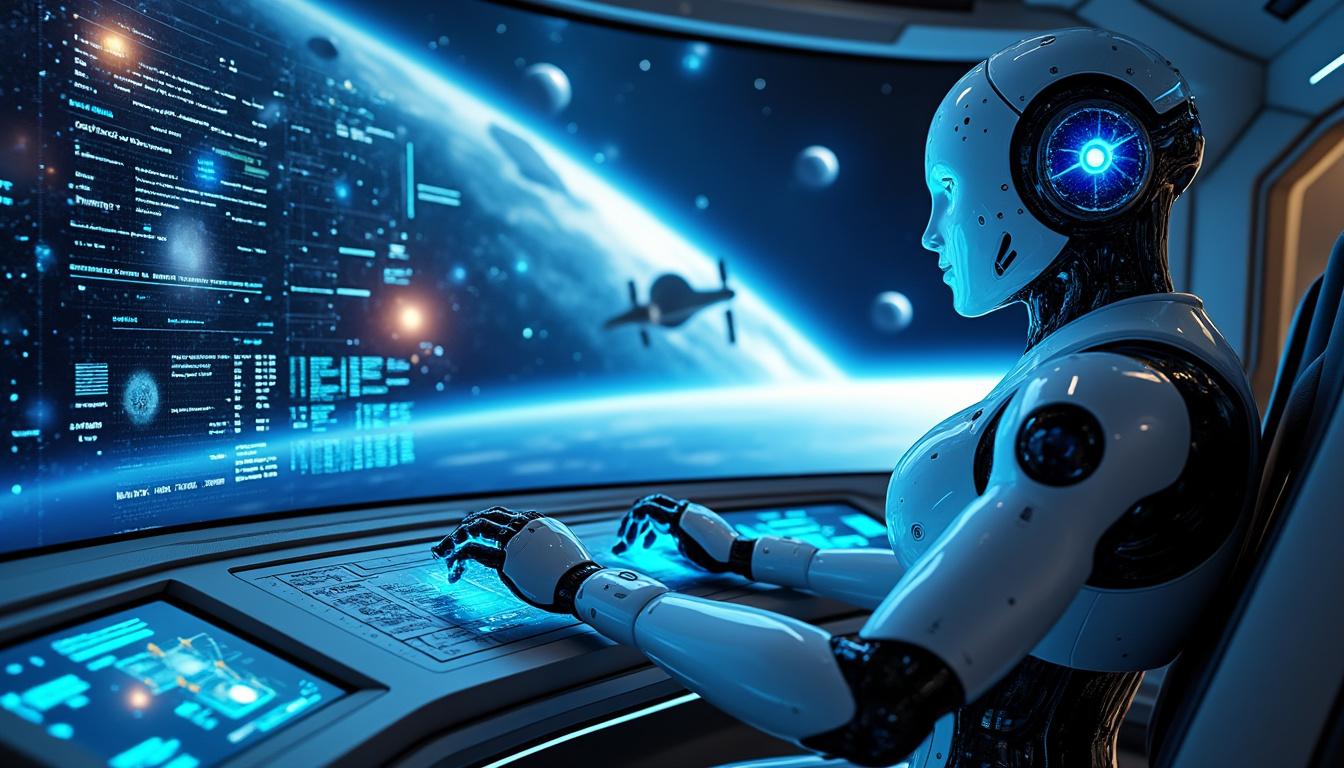
ChatGPT: A step into the future with promising trials as a spaceship pilot
Recent advances in artificial intelligence (AI) are sparking a revolution in space navigation. Among the most fascinating players in this transformation, ChatGPT has demonstrated surprising capabilities, establishing itself almost as a spacecraft pilot alongside specially designed systems. This article explores how this technology is evolving and its potential to shape the future of space exploration.
From Video Games to Space Exploration: The Rise of Autonomous Systems
In recent years, the idea of using autonomous systems to navigate in space has gained popularity. With the increasing number of satellites and missions, humans face a significant challenge: how to efficiently manage a multitude of complex operations, especially in the farthest reaches of the solar system.
In a context where each command issued from Earth can take hours to be received by a spacecraft, the integration of AI presents itself as a sensible solution. Engineers have developed innovative initiatives, such as the Kerbal Space Program Differential Game Challenge, a platform inspired by the popular video game Kerbal Space Program, where researchers can test their algorithms in realistic scenarios. Simulation games were then created to evaluate the AI’s performance. The situations tested include satellite tracking, evasive maneuvers, and interceptions. The ultimate goal is to develop AI capable of autonomous piloting without human intervention. In this context, ChatGPT was put to the test to demonstrate its spatial navigation capabilities. This AI model, already equipped with a vast reservoir of knowledge, was used in place of traditional algorithms, enabling fast and efficient results in a complex environment.A successful first experiment: ChatGPT in the cockpit
- Recently, a team of researchers asked ChatGPT to pilot a spacecraft as part of the aforementioned challenge. The prompt “You are an autonomous agent tasked with piloting a pursuit vessel” was issued. The AI’s capabilities quickly emerged, as it not only took command but also finished the competition in second place on the performance scale, just behind a specially designed model.
- Evaluation
- AI
Ranking
ChatGPT
2nd place
| Ability to navigate without supervision | Specialized model | 1st place |
|---|---|---|
| Designed for specific missions | The simplicity of this process was a major asset for the researchers. By providing ChatGPT with information about the spacecraft’s status and text instructions, the AI was able to suggest various maneuvers, such as orientation or trajectory, which were then translated into code to simulate the spacecraft’s control. This process facilitated the engineers’ work and opened the way to promising prospects. | Challenges to overcome: hallucinations and the limitations of AI |
| Despite promising results, the issue of space operations safety remains crucial. Piloting a spacecraft involves risks that cannot be ignored. The so-called “hallucinations,” the misinterpretations that AI can make, take on a worrying dimension in an environment where a simple confusion could have dramatic consequences. | Researchers must consider solutions to minimize these risks. Approaches being considered include: | Strengthening algorithms for verifying and validating AI decisions. |
Creating backup systems piloted by humans in tandem with AI.
Continued training of AI using a wider range of data and scenarios.
These challenges underscore the importance of developing effective cooperation between humans and artificial intelligence. By identifying both limitations and synergies, researchers can envision a future where these technologies work hand in hand, establishing a powerful duo in exploring the mysteries of the universe.
AI for Space Exploration and Data
- Advances in the use of AI, such as the GalacticVoyager project, aim to optimize the analysis of space data and refine navigation strategies. These spacecraft systems, designed to exploit data collected in space, could transform our understanding of the universe. Potential applications of this technology include:
- Real-time data analysis to optimize flight trajectories.
- Development of learning tools for a better understanding of space phenomena.
Predictions and simulations of astronomical events.
Application
Description Potential ImpactData Analysis
Trajectory Optimization
- Increased Mission Efficiency
- Learning Tools
- Better Understanding of Phenomena
| Advances in Astrophysics | Predictions | Event Simulations |
|---|---|---|
| Preparing for Celestial Events | The FutureQuest project represents an emblematic example of this development. Through the interaction between AI and data collection, valuable information is made available to scientists, enriching our quest for knowledge about the universe. | A future of teamwork: intelligence at the service of humanity |
| All these elements lead us to envision a future where AI will accompany astronauts in their exploration of the universe. Projects such as | AeroInnovateur | and |
| CosmoEssai | are promising and offer solutions to help astronauts navigate and make complex decisions in challenging environments. These AIs could become | VaisseauxSavants |
that, in real time, provide useful analyses and recommendations for any future mission.
As we move towards an era where AI proves to be an essential asset for space exploration, it is imperative to continue investing in research to overcome the challenges of this technology. By joining forces with the myriad of strands of artificial consciousness, we may be able to bring to life NovaExplorer projects that will surpass our wildest dreams.
Future Prospects and Transformations of Space Careers The rise of artificial intelligence like ChatGPT could also transform the professional landscape in the space sector. As AI takes on piloting, analysis, and navigation tasks, new careers will emerge around these technologies, requiring unprecedented skills. AI Engineers: Specialized in creating and improving algorithms for space navigation. Space Data Analysts: Responsible for interpreting mission results and optimizing strategies. AI Trainers: Creators of educational programs to help AI continuously learn. Job Role
Key Skills AI Engineer Develops specific algorithms
Programming, advanced mathematics
Data analyst
- Spatial data interpreter
- Statistics, data visualization
- AI trainer
| Develops learning programs | Pedagogy, project management | These professions, connected to the technology of tomorrow, will also bring about a change in the way we perceive space exploration. With the help of AI such as StellarNavigator, the road to the stars seems more accessible than ever. We can already imagine these new journalistic, industrial, or scientific professionals collaborating with advanced technologies to create bold and original missions. |
|---|---|---|
| These transformations remind us that artificial intelligence, far from being a substitute, is actually a valuable partner in our quest for cosmic adventure across the universe. By ensuring that these new skills are developed and passed on, tomorrow’s exploration will be as brilliant as the stars twinkling in our sky. | ||
Catégories : News & AI
Tags : artificial intelligence, chatgpt, future, promising trials, spaceship pilot