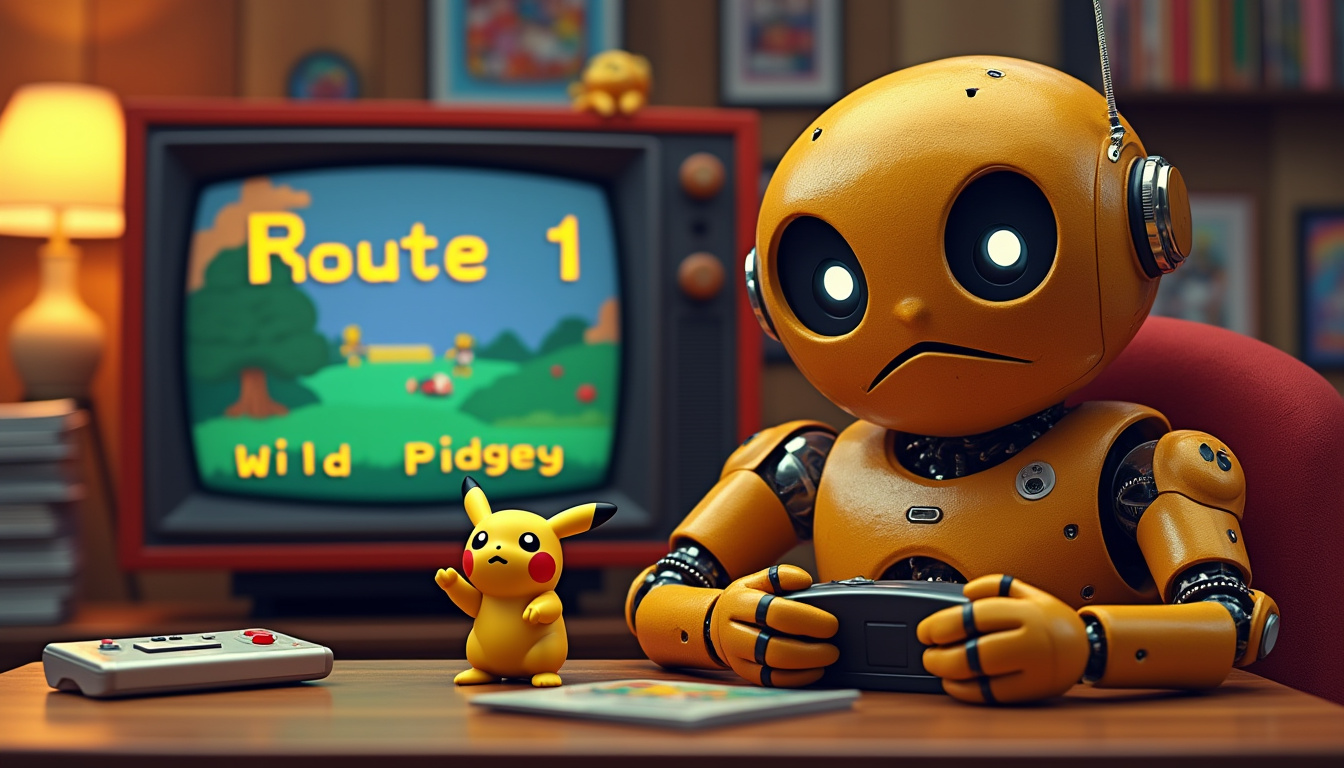
Anthropic AI Claude is having trouble clearing Pokémon Red: Discover the sticking points
For several weeks, Anthropic’s AI model, Claude 3.7 Sonnet, has been attempting to complete Pokémon Red, an iconic 1996 video game. While we often talk about the advances companies are making in artificial intelligence, this project highlights the current limitations of these technologies. Despite his promising start, Claude encountered numerous blocking points in this challenge. This article explores the challenges Claude encountered along the way, analyzing his performance, his mistakes, and the implications for future technology.
Claude’s first steps in the Pokémon game have been encouraging, with the acquisition of several badges indicating his ability to understand and manage battles. However, his inability to progress beyond certain levels raises concerning questions about artificial intelligence and its development. Today, we will examine the various aspects that complicate Claude’s goal, as well as the lessons to be learned from this experience. Claude’s Promising Debut in Pokémon Red
Initially, the “Claude Plays Pokémon Red” project seemed like a bold idea from Anthropic. Indeed, Claude demonstrated her ability to understand the basics of the game, earning several badges indicating that she can effectively manage battles.
Claude’s Early Successes
Claude’s first attempts showed that she was able to guess the necessary strategies. For example, she clearly understood that an Electric-type Pokémon is ineffective against a Rock-type Pokémon. This demonstrates logical reasoning to adapt her battle choices. Claude was able to follow dialogue and complete simple missions, allowing her to navigate the pixelated world of Pokémon.
Claude’s Battle Strategy During battles, Claude demonstrates strategic thinking. She manages to manage different situations by adapting her approach and observing her opponents’ reactions. This proves that the technology behind Claude is advanced compared to other AI models, which are often stuck in random choices and unable to adapt to circumstances. The Challenges Encountered by Claude After some initial successes, Claude began to face notable difficulties that prevented her from completing Pokémon Red. The problems she encountered highlight interesting gaps in the current development of artificial intelligence.The Issue of Visual Perception One of Claude’s greatest challenges lies in her ability to interpret the game’s graphics. Although Claude can follow the images displayed on the screen, she doesn’t always understand what she sees. The pixelated characters and blurry environment complicate its ability to navigate the game efficiently. For humans, a simple shape like a gray square is immediately identifiable as a wall, but for Claude, it remains a mystery. More realistic graphics could potentially improve its understanding of and interaction with the world of Pokémon.Memory Issues
Another major difficulty lies in Claude’s memory. Although it can store up to 200,000 information tokens, when it reaches its limit, Claude must summarize the data. This leads to the loss of crucial information, severely hampering its efficiency. In some situations, Claude relies on incorrect information it has already stored, leading it to spend hours searching for the exit to incorrect areas of the game.
Implications for Artificial Intelligence
Claude’s experience raises essential questions about the limits of artificial intelligence applied to video games. Although Claude is an ultra-modern model, his comprehension and memory problems call into question claims that AI technology will soon surpass humans. This raises questions about the true potential of artificial intelligence to learn and reason. Critical Thinking and Self-Correction Beyond the satisfaction of achieving goals or understanding dialogue, AI must develop critical thinking skills. Claude sometimes demonstrates the ability to change methods when encountering impasses, but she does not always question her assumptions. An intelligence that could autonomously doubt or correct its errors would be a spectacular advancement in the field of AI. The Path to an Intelligent Future Clearly, for artificial intelligence to reach its full potential, improvements must be made. Not only do memory and visual perception need to be refined, but it’s also essential to incorporate a more developed form of reasoning. Claude can already make adaptations in certain scenarios, but this remains limited. Moving forward, research and development in the field of artificial intelligence must focus on these aspects to prepare for the creation of a truly intelligent model.
The Future of Claude and Video Games The challenges Claude encounters in Pokémon Red may seem insignificant at first glance, but they reveal a lot about the future direction of artificial intelligence. While we continue to explore and understand these limitations, the road to an effective and autonomous AI model in the field of video games is still long. Lessons Learned from the Experience with Claude Claude offers valuable insight into the capabilities and limitations of contemporary artificial intelligence. The struggles she endures illustrate not only the inherent difficulties of AI systems, but also the immense potential for improvement. Every mistake Claude makes can be seen as a learning opportunity, leading to more efficient future development.A New Era for AI and Video Games
The technological building block behind Claude represents a promise of an intelligent future that seems both near and distant. As companies like Anthropic continue their quest for excellence, it’s clear that the road ahead is fraught with challenges. In a world where AI capabilities continue to evolve, the ultimate result of a Claude that can truly solve complex video game situations is yet to come.
Catégories : News & AI
Tags : anthropic, claude, difficulties, ia, Pokémon Red