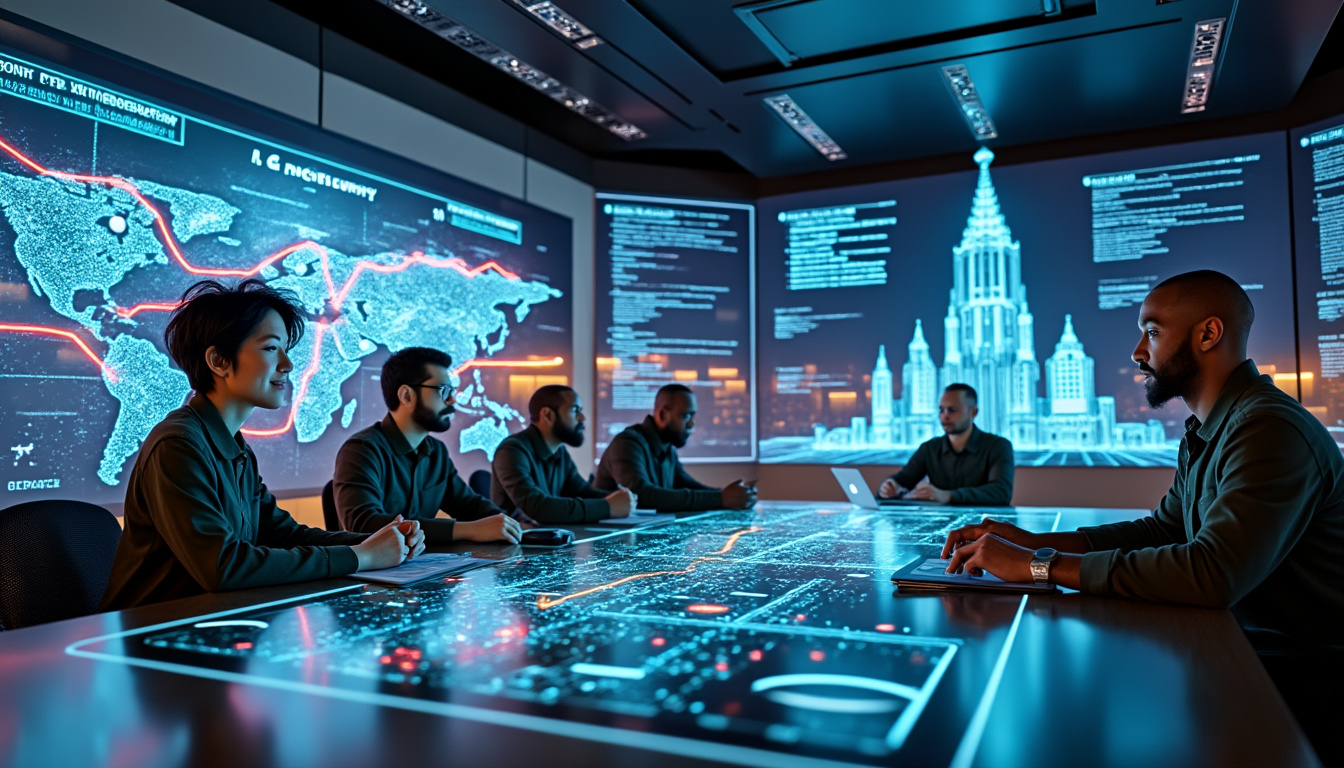
Cyberwar: in Nancy, an immersive simulation places artificial intelligence at the center of defense strategies against emerging threats
Recently, Nancy was the scene of a significant event in the field of cyber defense. The largest academic cyberwarfare exercise, titled “Cyber Humanum Est”, brought together students, military personnel and businesses for an unprecedented immersive simulation. The event highlighted the growing use ofartificial intelligence in modern defense strategies. By immersing 200 participants for three days in a crisis scenario, this simulation revealed how AI is becoming an essential asset from the conflict in Ukraine to the tensions in Gaza. This gathering made it possible not only to evaluate skills, but also to test innovative tools in the face of hybrid threats targeting critical infrastructures.
Context of the Cyber Humanum Est exercise
The Polytech Nancy campus was transformed into a real digital battlefield during this exercise. Architectured by the Cyber Defense Command (COMCYBER), the event was designed to simulate a crisis where participants had to react to various threats, mixing deepfakes, handling of critical infrastructure and psychological warfare. The three days of intense activity were marked by realistic challenges, making the exercise all the more relevant in a world where the lines between conventional warfare and information warfare are becoming blurred.
This 2025 edition is distinguished by the integration of innovations relating togenerative artificial intelligence, highlighting the growing need for evolution in defense strategies. Participants had to deal with everything from sophisticated cyberattacks to the spread of misinformation, proving that contemporary challenges require a far more complex tactical approach than ever before.
Why is artificial intelligence crucial?
As part of the exercise, the importance ofAI quickly established itself. Faced with automated attack systems, the speed of reaction of human operators becomes a critical factor. Using advanced algorithms, the military relies on AI to identify targets, analyze data and even predict enemy movements. This is what makes this technology indispensable in the field of modern cyberwarfare.
For example, the IDF forces already use AI systems to cross-reference data from various sources such as satellites and social networks. Such an approach allows not only better responsiveness but also a clearer vision of the field of operation. Putting this technology into practice during the exercise offered participants the opportunity to discover its concrete applications in a crisis context.
Simulation of major crises and human challenges
During this exercise, participants were confronted with a continuous 36-hour sequence, simulating a series of major crises. This intense immersion made it possible to highlight not only the technological challenges but also the role of human factor in the conduct of cyber operations. Operator training has never been more pressing, because faced with increasingly complex AI systems, decision-making must fall to humans, adequately trained to manage such crisis situations.
The various components of the teams – ranging from students to experts – had to coordinate their efforts to protect critical infrastructure while countering ingenious cyberattacks. The use of automated systems can often detect anomalies and initiate a response, but a human understanding of the behavioral and social implications remains irreplaceable. This blend of technology and human expertise will remain a central challenge in the future.
An overview of the results and the future of cyber defense
In light of the results of the exercise, it is essential to explore how the lessons learned can influence the future of the cyber defense. This full-scale simulation revealed the importance of increased collaboration between the private sector and public institutions. Partner companies, such as Siemens And Orange, illustrate the need for a collective effort to face these new digital threats.
In the future, the strategic integration of AI into defense systems will not be sufficient without a strong collaborative ecosystem. Initiatives like those observed during this exercise illustrate how future cyber defense professionals must be trained not only on technology, but also on teamwork and crisis management. The challenges of tomorrow will require unprecedented agility and an ability to rethink the responses traditionally used in the face of cyberattacks.
Establish collaborations for strengthened defense
Modern cyber defense is more than ever a collective effort. The exercise Cyber Humanum Est perfectly illustrates how different actors can collaborate to erect a robust barrier against emerging threats. To ensure effective defense, it is imperative to establish strong partnerships between government, industry and higher education institutions. The companies involved in the exercise demonstrated that they have a vital role to play, bringing advanced technologies as well as valuable expertise.
The training of a new generation of cybersecurity experts relies on the synergy between these actors. In an ever-changing environment, it becomes essential to create educational programs that integrate not only technical knowledge, but also team management and strategy skills. As threats transform, this comprehensive approach will help strengthen defenses.
Next steps for AI integration
At the end of the exercise, several questions emerge regarding the integration of AI into cyber defense strategies. Research and development must go hand in hand with practical implementation of AI tools. It will be crucial to continually evaluate these systems to ensure they can evolve with the threat landscape. By placing emphasis on continuing training and experimentation, operational staff and researchers will be able to anticipate and adapt to unforeseen situations.
Practical seminars and workshops, like those offered during the exercise, should become standards in cybersecurity training programs. Additionally, sharing best practices between institutions and industry will be essential to strengthen operational capabilities in this gaming domain in order to effectively counter opponents using advanced technologies.
Catégories : Non classé
Tags :