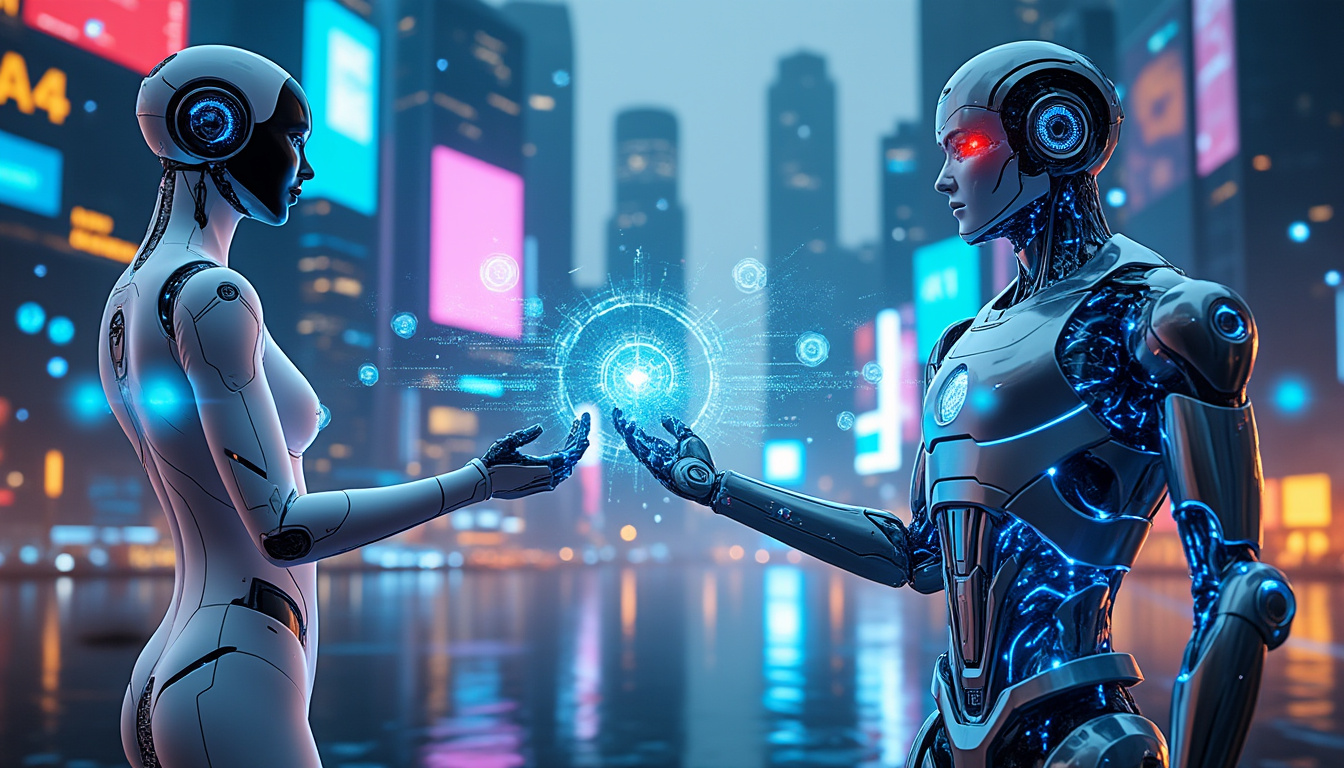
A2A: Google’s innovative protocol to enable exchanges between artificial intelligence agents
In a constantly evolving technology sector, Google Cloud made a remarkable debut with its new protocol, Agent2Agent (A2A), at its annual Next 25 conference. This protocol, presented as an essential tool for orchestrating exchanges between artificial intelligence agents, nevertheless raises questions. As the AI ecosystem evolves rapidly, the need for seamless communication between these agents becomes undeniable. The project is part of a broader trend of AI agent proliferation, already anticipated by Google as early as April 2024. The question therefore becomes: how will this tool transform our relationship with artificial intelligence?
The challenges behind Agent2Agent: a response to the proliferation of AI agents
To understand the context that led to the development of A2A, it is essential to revisit the challenges encountered in using intelligent agents. These entities, although powerful, must normally communicate effectively with each other to solve complex tasks. This is where A2A positions itself as a bridge connecting different systems and platforms. The Need for Harmonized Communication
Communication between AI agents is anything but trivial. Indeed, each agent can have its own specificities, protocols, and ways of processing information. Consequently, without a unifying link, tasks requiring multiple agents can quickly become chaotic. Here are some elements that explain the importance of such a protocol:
System Interoperability
- : A2A facilitates the integration of agents developed on various frameworks. Synchronized Communication
- : Thanks to A2A, agents can exchange information in real time in a structured manner. Operational Efficiency
- : By improving communication, A2A can reduce response times to user requests. The Challenge of the Model Context Protocol (MCP)
The Model Context Protocol (MCP) was introduced as a technology to structure discussions between AI agents. However, it is becoming clear that it does not cover all communications within multi-agent systems. This is where A2A comes in, not to replace MCP, but to complement it.
This complementarity underscores the importance of technical nuance in communication management. According to experts at Google Cloud, while MCP is effective at managing simple, formatted exchanges, A2A allows for a more significant depth of interaction between agents. This opens the door to more advanced discussions and better task processing.
Technical Architecture of A2A
To dive into the technical aspects, A2A is based on a structured exchange model. It is fundamentally divided into three actors:
User
- : The person who interacts with the agent system. Client
- : The person who relays a user request to a remote agent. Remote Agent: Who actually executes the request.
- Exchanges between these three entities are primarily carried out via the HTTP protocol, with real-time updates facilitated by Server-Sent Events (SSE). Also noteworthy is the use of the JSON-RPC 2.0 format to ensure the clarity and accuracy of the data exchanged. The Benefits of A2A for Businesses
In 2025, businesses will be navigating an increasingly complex environment. Data access, responsiveness, and the efficiency of artificial intelligence systems have become priorities. With its adoption by more than 50 technology partnerships, A2A positions itself as a strategic asset in this context.
An Ecosystem Enriched by Partnerships
Strategic alliances formed with technology giants such as Salesforce, IBM, and Microsoft
Open up a multitude of possibilities. A2A promises to connect agents across the entire business ecosystem, while providing them with a common language for collaboration, regardless of platform. This development enables the seamless integration of AI agents into business processes.
Tangible Use Cases As part of the A2A implementation, several use cases are emerging. Here are some concrete examples:Use Case DescriptionExpected Impact Recruitment Management of applicants via an automated selection system.
Improved operational efficiency and reduced processing time.
Customer Service
| Help manage customer requests with AI-assisted agents. | 24/7 accessibility and rapid response to customer queries. | Data Analysis |
|---|---|---|
| Evaluation and synthesis of sales data by agents. | Providing an accurate and up-to-date view of sales performance. Ethical and Practical Implications to Consider | However, the implementation of A2A is not without its share of complications. Ethical concerns surrounding data management and the autonomy of AI agents must be taken into account. While companies such as Amazon and Facebook are nurturing their brand image in the face of data protection issues, Google must also pay attention to how A2A will be perceived by the international community. |
| A2A: Towards Widespread Adoption or Persistent Distrust? | Despite the enthusiasm generated by the A2A announcement, distrust is beginning to emerge. Concerns surrounding Google’s intentions regarding the centralization of this protocol are legitimate. Critics point out that Google’s management could harm open source, implicitly favoring its own ecosystem at the expense of agent diversity. | Criticism and Skepticism Around Control |
| RunReveal co-founder Alan Braithwaite raises a valid point about the potential monopoly Google could establish. He emphasizes that by controlling A2A, Google could become the sole source of trusted agents, potentially leading to a concentration of power within the industry. The question then becomes: how can we ensure that agent diversity isn’t undermined by excessive control? | The Importance of the Open-Source Community | As Google focuses on the deployment and adoption of A2A, the open-source community still has a crucial role to play. Feedback and suggestions for improvement are essential to making the system robust and adaptable to emerging needs. Initial feedback is encouraging, as evidenced by the over 600 stars it has received on GitHub, but much remains to be done to make it a truly collective success. Looking to the Future |
In summary, while A2A is presented as the integration tool between artificial intelligence agents, it remains to be seen how this protocol will influence the dynamics of the technology industry. In the meantime, it is essential to keep a critical eye on the evolution of its governance and its impact on the entire sector. Thus, 2025 could mark a decisive turning point in cooperation between AI agents.
Catégories : Non classé
Tags : a2a, AI exchanges, google protocol, intelligent agents, technological innovation